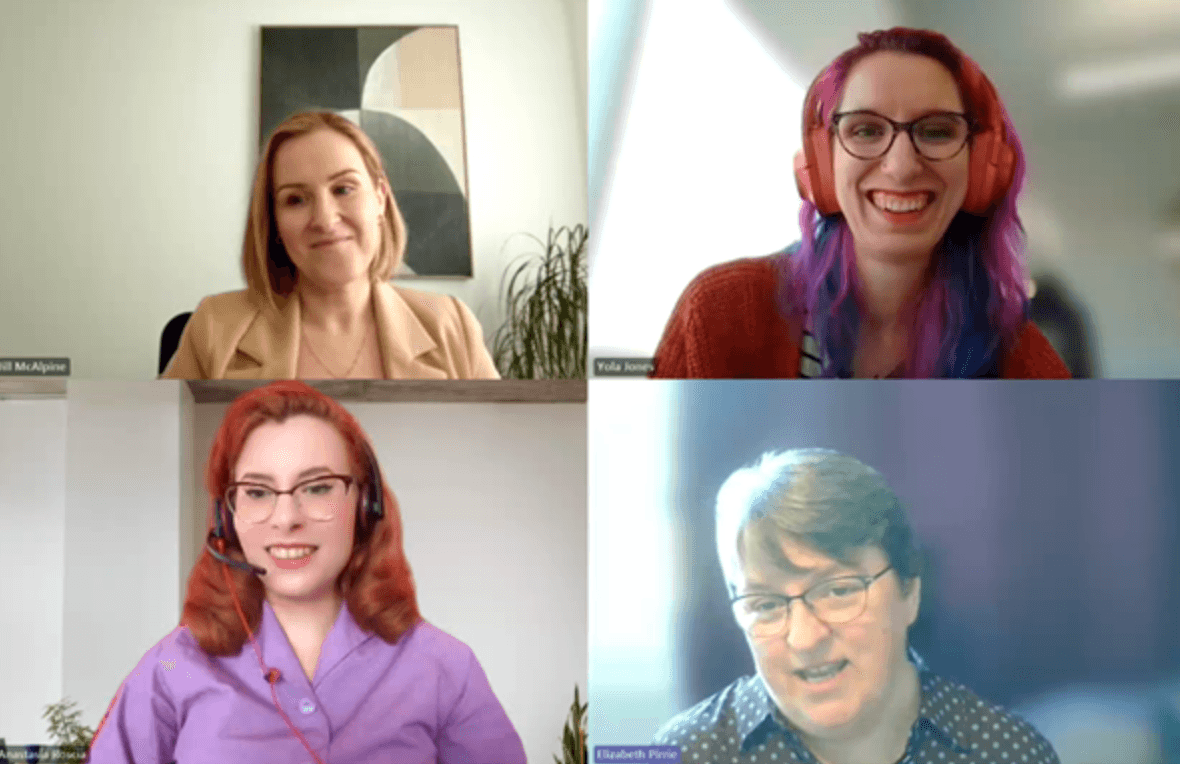
In March 2025, the EDAS Future Leaders Network hosted an event on Female Entrepreneurship and Economic Development to celebrate International Women’s Day and Women’s History Month.
The event had three guest speakers:
Jill McAlpine – Founder of inpurpose, Events Coordinator for Highland Business Women
Yola Jones – Co-Founder and CTO of Seluna
Elizabeth Pirrie – CEO of AccelerateHER, COO of Investing Women
Our three guests participated in a panel discussion, hosted by our committee member Anastasia Roscia. This blog post intends to capture some of the key takeaways from the event, under the following topics:
- The journey into entrepreneurship
- Lived experiences of prejudice
- Female founders accessing funding
- The contribution of female entrepreneurship to economic development
The journey into entrepreneurship:
The panel discussed that women often take unconventional paths into entrepreneurship.
Yola shared her journey of becoming a co-founder, originating from a STEM background with no prior entrepreneurial experience. Her technical expertise provided her with a unique set of skills that are incredibly useful within entrepreneurship. It was someone else who recognised the transferability and applicability of her skillset, leading her to become the co-founder and CTO of med-tech startup Seluna.
Elizabeth shared that this has been a recurring theme in her work with female founders. Women often find themselves with a business and others have to point out to them that they are an entrepreneur.
Further to this, the term ‘entrepreneur’ is not one that many women tend to identify with or use. The panel agreed that ‘female founder’ is generally a more preferred and relatable term. Many women feel a disconnect with the word ‘entrepreneur,’ largely shaped by historical societal stereotypes surrounding the term. This opens up a broader conversation about the use of ‘female’ before ‘founder’ or ‘entrepreneur’.’ As highlighted in a Forbes article, using the word ‘female’ can serve to acknowledge and recognise the unique barriers women have had to overcome in the entrepreneurial space1.
Experiences of prejudice:
The panel shared their personal experiences with prejudice, highlighting that it remains a persistent issue within this space. Yola spoke specifically about her experiences in tech-specific environments, where her qualifications have often been underestimated, and her voice overlooked, despite being a CTO.
The panel also discussed being implicitly or explicitly asked about their current or future family plans. This line of questioning can leave female founders feeling as though the potential of their business is being judged based on their response.
Female entrepreneurs accessing funding:
The panel was asked to share their perspectives on the challenges female-led businesses face in accessing funding – particularly because, although one in five entrepreneurs in Scotland is a woman, they receive just 2% of institutional investment capital.2.
Much of this disparity was attributed to the lack of gender diversity among investors. Increasing the number of women in investment roles is seen as a key step towards levelling the playing field. Currently, only 27% of UK investment professionals are women, with just 6% being women from ethnic minority backgrounds3. Additionally, only 16% of Investment Committee members are women. Until greater progress is made in diversifying those who control capital, funding inequalities are likely to persist.
While these statistics highlight the scale of the challenge, a key takeaway from the panel was the importance of not letting the numbers overshadow the progress that has been made. Scotland has an incredibly vibrant angel investment space, and the work of organisations such as Investing Women are playing a leading role in creating a more equitable funding landscape for female entrepreneurs.
Female entrepreneurships contribution to Economic Development:
When asked about the role of female entrepreneurs in economic development, the panel shared anecdotal insights on their personal experiences working with women founders. They shared that female-led businesses often strive to address broader societal challenges, not just generate profit. This insight has been evidenced by research undertaken by the Global Entrepreneurship Monitor, which reported that women are slightly more likely than men to cite “making a difference in the world” as a key motivation for starting a business4.
Beyond their initial motivations, research has found that female-led businesses that secure funding show better returns on investment. They also tend to be more conservative in their projections, offering a more stable, lower-risk investment opportunity56.
Furthermore, an increasing number of female entrepreneurs are becoming angel investors themselves, which is positively influencing the number of women-led businesses that receive funding7. Female entrepreneurs are also helping shape the future of entrepreneurship, by offering mentorship to young or aspiring entrepreneurs. This results in wider social, commercial, and economic benefits. When discussing the importance of having a network, the panel stated:
“In Scotland specifically, that network is so incredibly valuable, but it is so difficult to find.”
This highlights the need to make networking opportunities more inclusive and accessible, including scheduling them at times that accommodate a wider range of attendees with varying work and family commitments.
To summarise the impact that female entrepreneurs have on economic development, the panel captured it with this quote:
“When we back female founders, we don’t just create jobs – we create ecosystems of opportunity that benefit everyone.”
A note on the importance of further learning:
The panel called for businesses to reward time spent learning about other people’s lived experiences. To build a business that contributes to societal good, it is crucial to ensure it benefits those with experiences different from your own. Successfully achieving this requires learning from others, which takes time. The panel stressed that this learning process is part of the job and should be compensated.
Closing note:
Thank you again to our panel and those who attended the event – it was an interesting and thought-provoking discussion.
The next event organised by the EDAS Future Leaders Network will take place on the 24th of June from 13:00 to 14:00, on the topic of Artificial Intelligence. If you are interested in attending this event, or joining the network, you can do so here.
You can also join our LinkedIn group here.
Recommended Reading:
The Mastercard Index of Women Entrepreneurs
Supporting Women’s Enterprise in the UK by Federation of Small Businesses – Issuu
Pathways: A New Approach for Women in Entrepreneurship
‘Invisible Women: Exposing Data Bias in a World Designed for Men’ by Caroline Criado Pérez